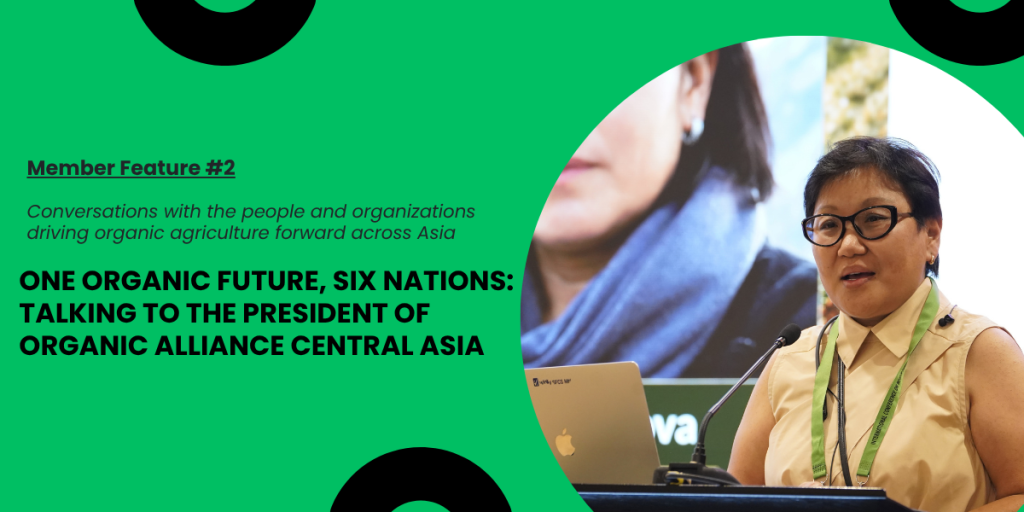
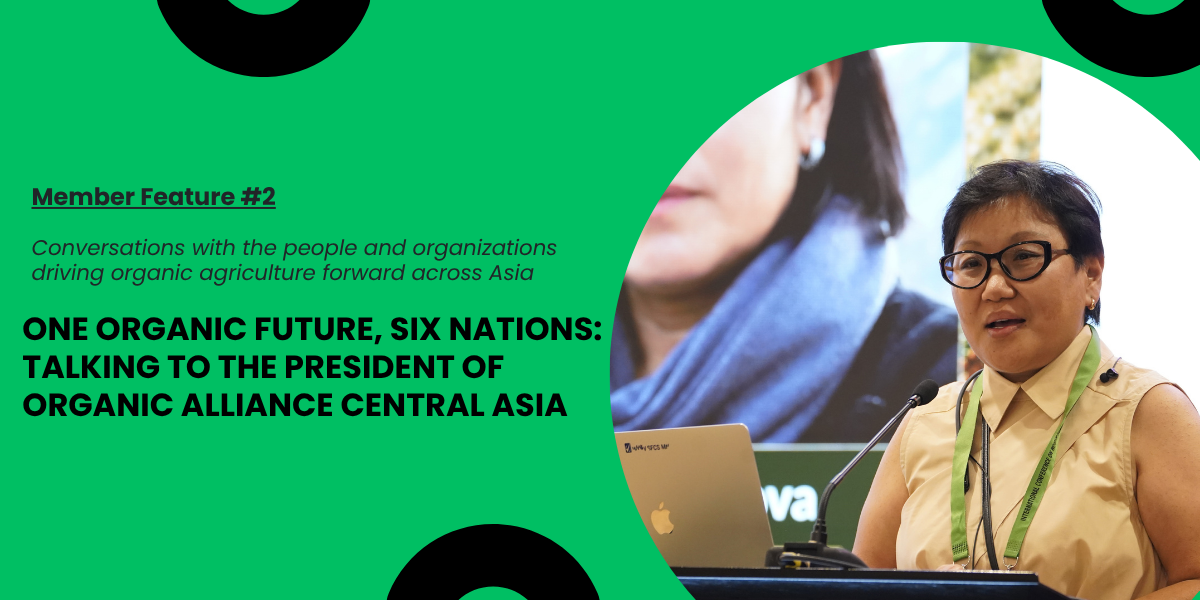
For Ms. Tungalag Lkhundevjamts, conversations about organic agriculture begin not with farming but with people. As President of Organic Alliance Central Asia (OACA), she leads one of the region’s newest efforts to bring farmers, researchers, certification bodies, businesses, government institutions and civil society organisations into the same conversation. But ask her about the Alliance and she doesn’t describe an organisation. She describes a realisation — that the problems facing organic agriculture in Central Asia are too big for any one country to solve alone.
A Shared Realisation
The idea took shape at the First Central Asian Organic Forum & Expo, held in Bishkek in 2024. Representatives from Kyrgyzstan, Kazakhstan, Uzbekistan, Tajikistan, Turkmenistan and Mongolia came together with different agricultural systems, priorities and experiences. As the conversations unfolded, they realised they shared many of the same challenges and aspirations for the future of organic agriculture.
“We discovered that we share many of the same opportunities and challenges — developing organic markets, strengthening certification systems, improving farmers’ capacities, increasing consumer awareness, and gaining greater recognition for Central Asia in the global organic movement.”
That realisation is what turned the forum into something more than a one-off event, Ms. Tungalag says. “Organic Alliance Central Asia was born from a shared realization that the future of organic agriculture in our region cannot be built by individual countries working alone.”
Instead of creating separate initiatives, the countries decided to work together through a single regional platform. That shared vision led to the establishment of the Silk Road Ambassador for Peace NGO, registered in Mongolia at the end of 2025, which now serves as the Alliance’s coordinating organisation, bringing together organic associations, certification bodies, researchers, businesses, government institutions, farmers and civil society organisations to promote cooperation, knowledge exchange and regional partnerships.
More Than a Method of Farming
For Ms. Tungalag, organic farming is not simply about production methods or certification checklists. It is a way of thinking about society as a whole. “For us, organic agriculture is far more than a method of farming. It is a pathway toward healthier people, healthier ecosystems, stronger rural communities, and more resilient local economies. It contributes to climate action, biodiversity conservation, food security, and the preservation of traditional knowledge while creating opportunities for future generations.”
That same instinct to connect things shapes how she talks about the region itself. She keeps returning to the Silk Road, not as a history lesson, but as a working metaphor for what cooperation could look like now. “Inspired by the historic Silk Road — which connected civilizations through trade, culture, and mutual understanding — we believe organic agriculture can become a modern bridge for cooperation across Central Asia. Through collaboration rather than competition, we hope to position our region as a recognized contributor to the global organic movement and to sustainable development.”The Alliance is not interested in countries competing with each other for the same markets. It wants knowledge, innovation and experience to move freely across borders, the way goods once moved along the old trade routes.
Organic agriculture is still at an early stage in Central Asia, but Ms. Tungalag does not see the region as falling behind. She points to growing consumer awareness, increasing government interest in sustainable agriculture, and a rising recognition among producers that organic farming offers both environmental and economic opportunities. Several countries have already introduced organic legislation, national standards, certification systems and support programmes, and interest is also growing in organic livestock production, medicinal plants, fruits, vegetables, and the traditional agricultural products the region already grows well.
None of this comes easily, though. Central Asia has real natural advantages, low-input farming systems, vast grazing land suited to organic livestock, and distinctive products with genuine export potential, but land and climate only go so far. “Small producers often struggle to access premium markets because of certification costs and limited market connections.” Ms. Tungalag does not treat this as a problem for individual countries to solve on their own. She sees it as exactly the reason the Alliance needs to exist: “We believe that collaboration, education, policy support, and stronger regional networks are essential to overcoming these challenges.”
That same instinct toward partnership is what drew OACA into IFOAM Asia. Joining, she says, was not really a strategic decision so much as an obvious one, a matter of finding a community that already shared what OACA believed. “Joining IFOAM Asia was a natural step for our Alliance because we wanted to become part of a larger community that shares our values and vision. IFOAM Asia provides an important platform for knowledge exchange, networking, policy dialogue, and collaboration.” She is candid that the learning will run in both directions: “As a new regional alliance, we hope to learn from the experiences of other countries while also sharing the unique perspectives and opportunities of Central Asia.”
A Shared Future
Ask Ms. Tungalag what she’s most excited about right now, and one project comes up immediately. “One of our most exciting initiatives is the Third Central Asian Organic Forum & Expo 2026, which will be held in Ulaanbaatar, Mongolia. The Forum will bring together participants from across Central Asia and beyond to discuss organic policies, certification, research, trade, innovation, and regional cooperation.” Looking further out, she points to a set of technical priorities that will shape the Alliance’s next phase of work: expanding Participatory Guarantee Systems, sustainable certification, organic market development, climate-resilient agriculture, and regional capacity building.
Ask her where she wants the Alliance to be in a few years, though, and she does not talk about growth for its own sake. “Our vision is not simply to build another regional organization, but to create meaningful impact. We want more farmers, businesses, policymakers, and consumers across Central Asia to see that organic agriculture is not an idealistic concept — it is a practical pathway toward healthier communities, stronger rural economies, and sustainable development.” Ask her what success actually looks like, and the answer gets simpler, not more complicated. “We often say that although we come from different countries, we are one organic family. When one country discovers a better solution, everyone in the region should benefit from it.”
As one of IFOAM Asia’s newest members, OACA is arriving with a mix of humility and confidence. Her message to the wider community starts, simply, with thanks. “Our message is simple: thank you for welcoming us into the IFOAM Asia family.” She is upfront that there is a lot to learn from organisations across Asia that have been doing this work for decades, but equally clear that Central Asia is not coming to the table empty-handed. “We hope Central Asia can also contribute its own experiences, traditional knowledge, rich biodiversity, and unique pastoral heritage to our shared organic movement. Every region has something valuable to offer, and together we become stronger.”
She is inviting the wider IFOAM Asia community to the Third Central Asian Organic Forum & Expo 2026 in Ulaanbaatar, not just to talk shop, but to build the kind of relationships that make cooperation actually work. “It will be an opportunity not only to discuss organic agriculture but also to build friendships, exchange ideas, and strengthen cooperation across our region. Your participation would mean a great deal to us, and we would be honoured to welcome you.”
By the end of our conversation, she returns to the idea that has run through everything she’s said. “Organic agriculture is not just about producing food; it is about building trust, caring for people and nature, and creating a future that we can all be proud to pass on to the next generation. We look forward to growing together as one organic family.”