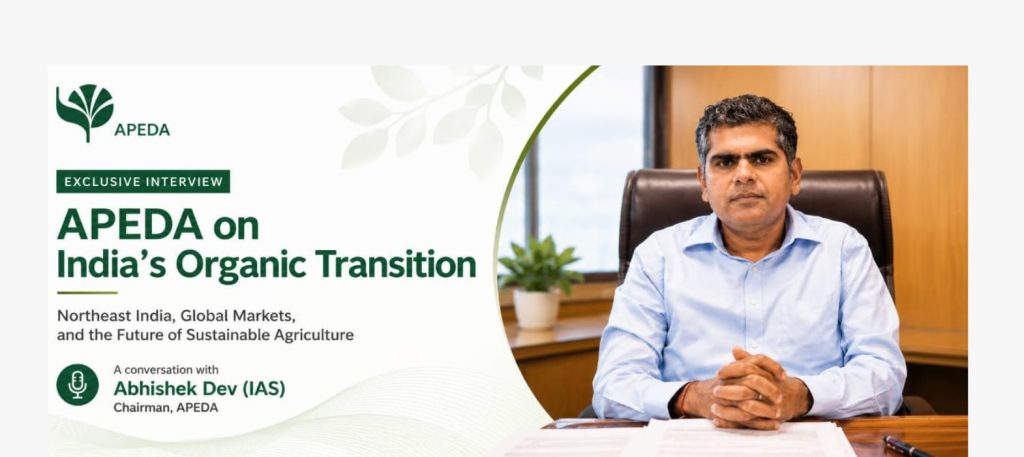
India’s Organic Transition: Northeast India, Global Markets, and the Future of Sustainable Agriculture
A conversation with the Chairman of APEDA
Across the hills, forests, and river valleys of Northeast India, organic farming has long existed not as a trend, but as a way of life.
Today, as global demand shifts toward traceable and sustainably cultivated food systems, India’s organic sector is steadily evolving into a key part of the country’s agricultural future. At the centre of this transition is the Agricultural and Processed Food Products Export Development Authority (APEDA), which has played a significant role in strengthening India’s organic ecosystem over the past two decades.
Over the last year, APEDA and IFOAM – Organics Asia have also built a growing partnership through initiatives such as Northeast India Organic Week and the World Organic Youth Summit — creating spaces for dialogue, market linkages, youth engagement, and international collaboration across the organic sector.
In this conversation, the Chairman of APEDA reflects on India’s evolving organic journey, the strategic importance of Northeast India, emerging opportunities in global organic markets, and the future of sustainable agriculture across Asia.
From niche movement to export ecosystem
Organic agriculture has evolved significantly within India’s agricultural export landscape over the years. What major shifts stand out to you?
India’s agricultural exports have expanded significantly, and within this broader landscape, the organic sector has emerged as a high-potential segment, driven by rising global preference for healthy, sustainable, and traceable food products.
Recognising this potential, APEDA, as the secretariat of the National Programme for Organic Production (NPOP), has played a key role in strengthening India’s organic framework since 2001. Recent revisions to the NPOP framework have also been accompanied by increased stakeholder training and capacity-building efforts to improve understanding around compliance requirements and organic production systems.
Over the last decade, important milestones have included the implementation of traceability systems and the introduction of grower group certification. India’s area and production under organic cultivation has expanded at a CAGR of nearly 7%, while organic exports have registered resilient growth at approximately 6% CAGR — reflecting growing global acceptance of Indian organic products.
This progress has been supported by focused government interventions, stronger certification and laboratory infrastructure, and mutual recognition agreements and arrangements with international markets.
“One of the most significant shifts has been the transition of organic agriculture from a niche practice to an increasingly mainstream and export-oriented ecosystem.”
The Chairman noted that the organic sector now represents more than an export opportunity alone. Increasingly, it is also being viewed as a pathway toward sustainable agriculture, farmer resilience, and long-term rural development.
Why Northeast India matters
While India’s broader organic ecosystem has grown steadily, APEDA has placed particular emphasis on Northeast India — a region increasingly seen as central to the country’s organic future.
What has driven this focus on Northeast India, and what impact do you hope these efforts will create for farming communities in the region?
North-East India occupies a distinctive place in India’s organic agriculture landscape due to its rich agro-climatic diversity, traditional low-input farming systems, and long-standing cultivation practices that naturally align with organic principles.
The region also holds significant potential for high-value products such as tea, spices, pineapple, citrus, and several GI-tagged indigenous commodities.
According to the Chairman, APEDA’s engagement with the region has been both strategic and developmental. As global demand increasingly shifts toward sustainably cultivated and premium-quality products, Northeast India offers unique advantages while also creating opportunities for inclusive rural development.
A major focus has been the creation of an end-to-end organic ecosystem — spanning production, certification, testing, value addition, and market integration. Through initiatives such as the Mission Organic Value Chain Development for North Eastern Region (MOVCDNER), efforts have also centred around capacity-building, certification strengthening, and improving access to premium domestic and international markets.
Over the past few years, APEDA has additionally worked to increase international visibility for the region through buyer-seller meets, exhibitions, and initiatives such as the first Northeast India Organic Week held in Meghalaya.
Looking ahead, the organisation’s priorities include improving export readiness, strengthening supply chains, promoting value-added processing, and deepening global market linkages for organic producers across the Northeast region.
“The region offers a compelling advantage while also creating opportunities for inclusive rural development.”
Emerging opportunities for Indian organics
Which Indian organic products are currently attracting the strongest international demand, and where do you see the greatest growth opportunities ahead?
India’s organic exports continue to witness strong global demand, particularly in product categories where the country enjoys a natural comparative advantage.
Organic basmati and non-basmati rice remain among the strongest export performers, while products such as tea, coffee, spices, oilseeds, honey, sugar, psyllium husk, and ashwagandha are increasingly gaining traction across markets including the United States, European Union, United Kingdom, Canada, and Australia.
Looking ahead, APEDA sees major opportunities emerging within high-value organic categories such as fruits and vegetables, cereals, coffee, tea, cocoa, spices, medicinal and aromatic plant products, processed fruit products, cashew derivatives, dry fruits, juices, and wellness-oriented commodities.
The broader shift reflects changing global consumer preferences around health, sustainability, traceability, and ethical sourcing.
“The greatest opportunities lie in high-value organic segments where global demand is expanding rapidly.”
Building a global organic ecosystem
One of the significant developments over the past year has been the growing partnership between APEDA and IFOAM – Organics Asia, particularly through initiatives such as Northeast India Organic Week and the 4th World Organic Youth Summit.
How do you see this partnership evolving moving forward?
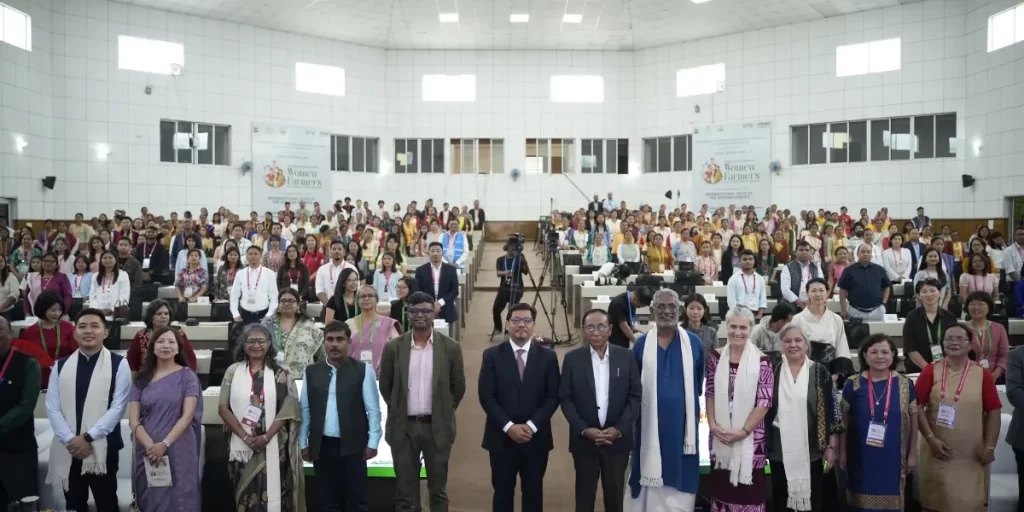
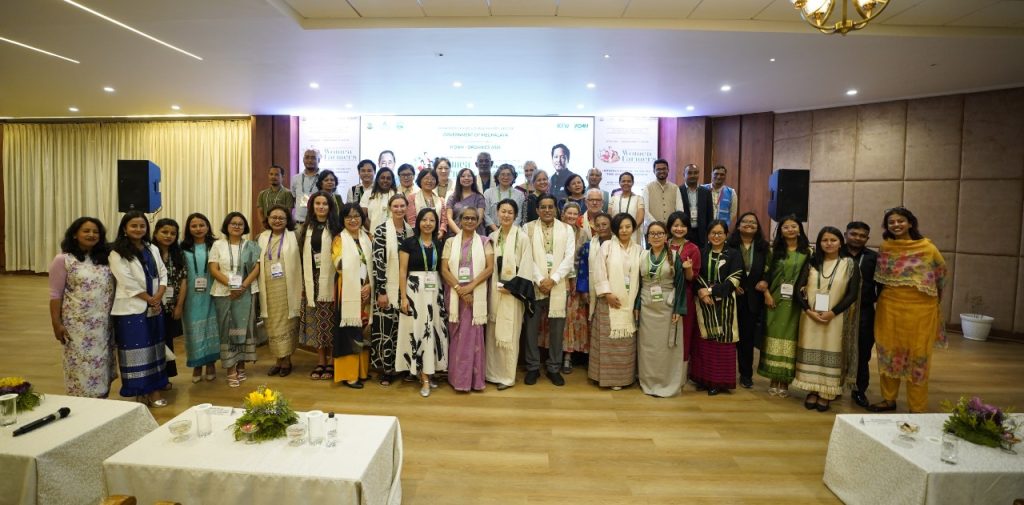
The Chairman described the Northeast India Organic Week in Meghalaya as an important milestone in positioning the region as an emerging hub for premium organic produce for both domestic and international markets.
Beyond showcasing products, the event created a platform for dialogue, knowledge exchange, and collaboration among farmers, FPOs, entrepreneurs, buyers, policymakers, and international delegates.
The partnership between APEDA and IFOAM – Organics Asia, he noted, has been especially meaningful in areas such as youth engagement, knowledge exchange, and strengthening the international visibility of India’s organic ecosystem.
Going forward, the collaboration is expected to deepen around:
- capacity building,
- youth engagement,
- international market linkages,
- innovation in value addition,
- and sustainable processing systems.
Alongside this, APEDA continues to strengthen export promotion initiatives through buyer-seller meets, participation in international trade fairs such as BIOFACH and World Food India, and investments in post-harvest and processing infrastructure across the Northeast region.
Together, these efforts aim not only to expand market access, but also to position Northeast India as a globally recognised source of high-value organic products.
“The World Organic Youth Summit helps engage future leaders of the global organic movement while enhancing the international visibility of India’s organic ecosystem.”
Beyond productivity: A message for the organic community
After years of working at the intersection of agriculture, policy, and international trade, what message would you most like to share with the organic farming community across Asia?
The Chairman emphasised that organic agriculture is no longer a niche movement, but is increasingly becoming central to conversations around sustainable food systems, farmer resilience, climate adaptation, and consumer well-being.
He reflected on the immense strengths Asia already possesses — from biodiversity and traditional knowledge systems to its rich agricultural heritage. If these strengths are supported by innovation, scientific practices, robust certification systems, and stronger market linkages, the region has the potential to emerge as a global leader in organic agriculture.
At the same time, he stressed that organic farming should not be viewed solely as an environmental responsibility, but also as a transformative opportunity capable of strengthening climate resilience, restoring ecosystems, empowering rural communities, and improving access to premium global markets.
Ultimately, the conversation returned to a larger idea — that organic agriculture today represents far more than an alternative farming system. It is increasingly being viewed as part of a broader transition toward sustainability-driven agricultural futures.